 Every city has its lifelines. If Mumbai has local trains and the famous dabbawalas, Kolkata has its metro rail since the 70s and 80s, and Delhi has its famous Ring Road and the DTC buses. By the way, Delhi also got metro rail some years back, and it rapidly became the National Capital’s lifeline. Have you ever imagined if these lifelines exchanged cities then what would have happened? Well, it’s not like Kolkata and Delhi does not have local trains, even Mumbai now boasts of metro, and every city has its share of dabbawala bhaiyas.
The Delhi explorer got tired of the air-conditioned metro rail, and thought of checking out a Delhi local. Before I share the account, I have to make a confession. Around five years ago, I didn’t even know if local trains existed in Delhi, thanks to a colleague, whose father works in the railways, she always used to board a local from somewhere in North Campus, and get down at the Pragati Maidan railway station.
The chosen destination for my exploring the Delhi local train was Ghaziabad. My companion and I bought an Rs 10 ticket from New Delhi Railway Station. The ticket counter is at the end of the Paharganj side of the station, there could a counter at the Ajmeri Gate side as well. Now, there is no designated platform for local trains in the New Delhi Railway Station. We must have asked not less than 20 people, from where we could board the local train? The most common answer we got was, “Hear out the announcements.” Luckily enough, we suddenly heard a train’s name being announced that was going via Ghaziabad and would depart from platform no 10.

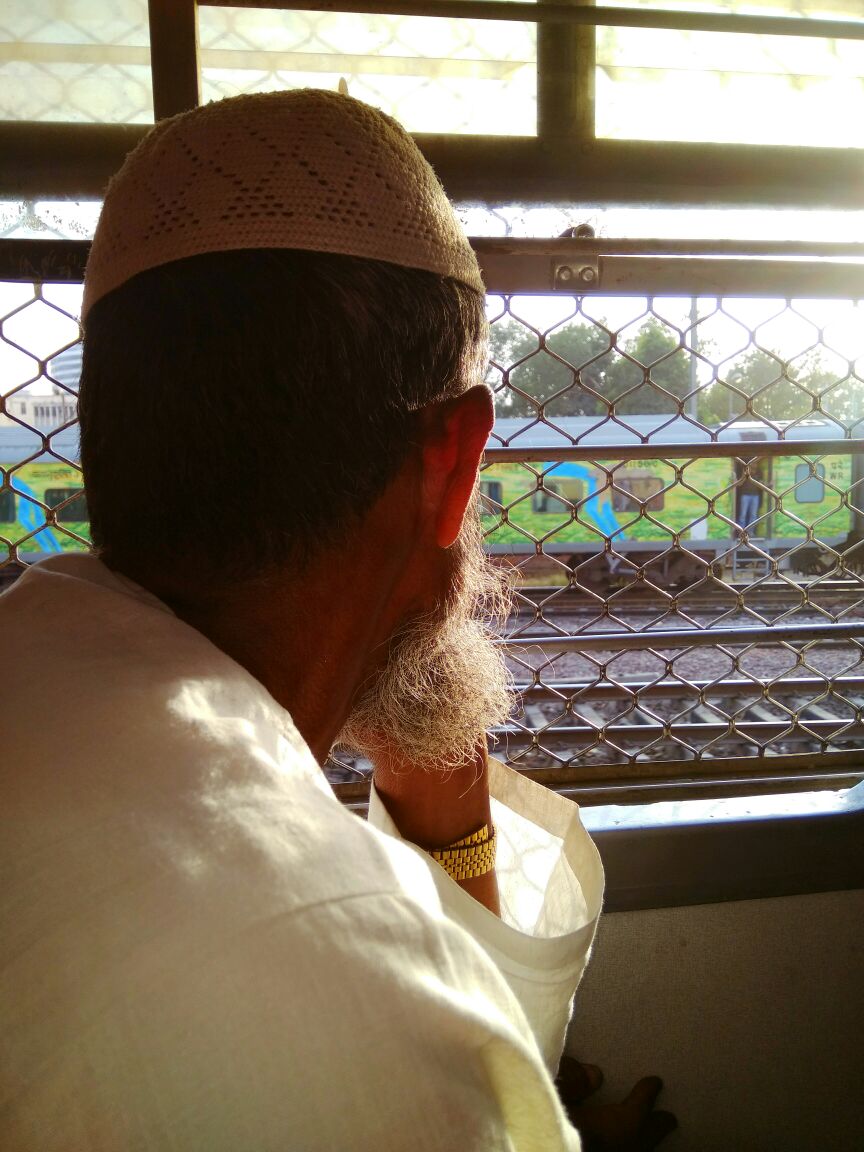
We rushed to platform no 10, to find a sizeable crowd waiting for the train. The train gradually wheeled into the platform. It resembled a Mumbai local train. The passengers quickly made their way into the coaches. I am not sure from where it was travelling, but most of the seats where already occupied. There was a mother with her two sons, an aged person in white kurta payjama and skull cap, a Bengali speaking family, several traders, who were carrying goods packed in jute bags and a few, who were returning after a hard day’s work.
The jute bags were kept below the seats; we shared the seat with the aged-person in kurta-payjama. The mother with her sons sat opposite to us. Some of the stations where the train stopped by enroute to Ghaziabad were Tilak Bridge, Pragati Maidan, Anand Vihar and Sahibabad. The train got packed by the time it reached Tilak Bridge; there was hardly any space to stand in the train.
Strangely, nobody spoke to anyone in the train; it’s so unlike a long train journey, where passengers get acquainted to each other as soon as the train starts moving. That’s the irony of a short journey, irrespective of whether its bus, metro or train, nobody speaks to anyone. The boys kept asking their mother at every station if they are supposed to get down there. The co-workers returning from office where chatting within themselves, one said loudly, “That day, the train halted a bit ahead of the designated station, and driver had to pull back. I had never seen something like that before.”
After an hour and a half we reached Ghaziabad. The conclusion drawn at the end of the journey was that a local train journey is a local train journey; it does not matter whether it’s Mumbai or Delhi.
 Delhi Explore